
RCN Colloquia
Next EPRV RCN Colloquium: Thursday, December 17th @ 8am Pacific US / 4pm UK
Connection details provided via RCN emails and Google Calendar
See below for schedule of upcoming talks & recordings of past presentations
Abstract: Measuring planet-induced radial velocities (RVs) at extreme precision requires separating planetary signals from stellar variability, which can dominate the RV measurements even with the most precise spectrographs. Multidimensional Gaussian Processes (multi-GPs) provide a powerful framework for disentangling planetary and stellar RV signals using ancillary stellar activity indicators. However, determining which combination of indicators best constrains the stellar contribution to the RVs remains challenging, particularly because conventional model comparison methods are not directly applicable when models include different sets of observables. In this talk, I will present a new information criterion specifically designed to compare multi-GP models based on their ability to explain the RV component. I will discuss how this criterion provides a quantitative framework for identifying the activity indicators that most effectively constrain stellar variability in RVs, enabling a more informed selection of multi-GP models. This approach offers a practical tool for improving stellar-activity modelling, an essential step towards detecting the low-amplitude signals of small planets with current and future extreme-precision RV instruments.
RCN Colloquia are generally scheduled for the 4th Thursday of the month at 8am Pacific US Time though we try to shift to avoid major holidays/conferences. If the speaker agrees, recordings are posted to our YouTube Channel and listed below for those unable to join in real time.
Upcoming Fall 2026 / Winter 2027 EPRV Colloquia
November 19th, 2026: Arvind Gupta [University of Arizona]
December 17th, 2026: Oscar Barragán [University of Warwick]
January 28th, 2027: Chris Watson [Queen's University Belfast]
February 25th, 2027: Jonathan Crass [Ohio State University]
March 25, 2027: Matteo Brogi [University of Turin]
April 22, 2027: Louise Nielsen [Ludwig Maximilian University]
May 27, 2027: Pradip Gatkine [UCLA]
June 2027: Skipping for EPRV 7 Conference
Use this Google Form to nominate a speaker for a future EPRV colloquium!
For a list of all previous RCN Colloquia speakers and topics, see this speaker archive document.
Recordings of Past RCN Colloquia
-
Laser and Photonic Tools for Radial Velocity MeasurementsScott Diddams [University of Colorado, Boulder]Watch on YouTube
-
Tracing spectral signatures of stellar granulation and magnetic activity using 3D MHD simulationsSowmya Krishnamurthy [University of Graz]Watch on YouTube
-
Chasing stellar noise with PoET: lessons from the first month of observationsNuno Santos [University of Porto]Watch on YouTube
-
Back to the basics: using statistical linear models to clean radial velocities for exoplanet detectionJessi Cisewski-Kehe [University of Wisconsin-Madison]Watch on YouTube
-
Magnetic Activity Diagnostics with LOST using the He I D3 LineMomo Ellwarth [Lowell Observatory]Watch on YouTube
-
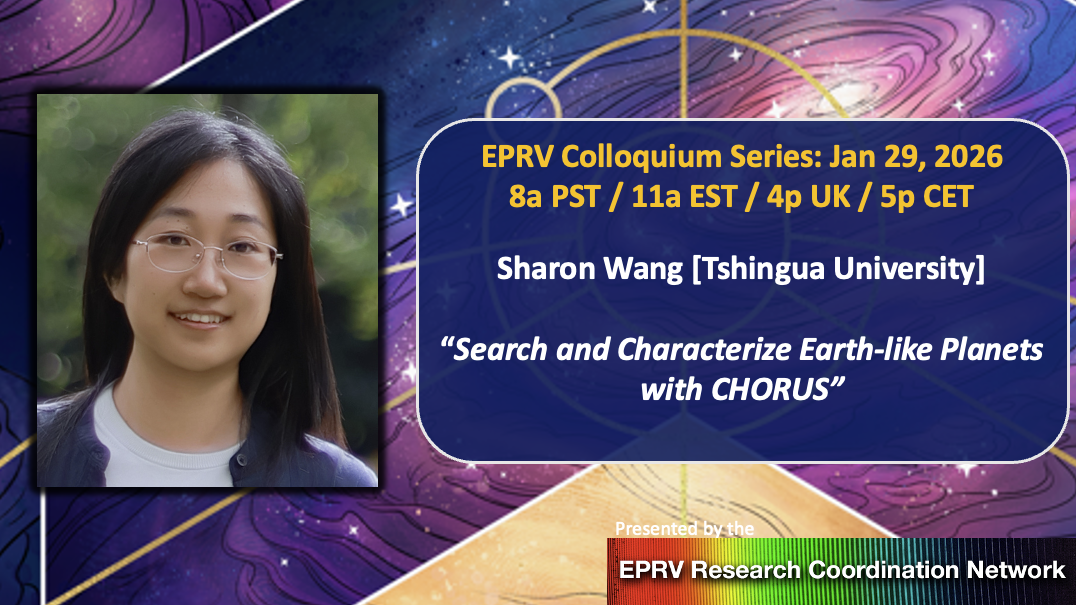
Search and Characterize Earth-like Planets with ChorusSharon Wang [Tsinghua University]Watch on YouTube
-
Know thy star: an introduction to stellar spectroscopy in the context of EPRVCis Lagae [University of Warwick]Watch on YouTube
-
Wavelength Calibration of EPRV SpectrographsFrancesco Pepe [University of Geneva]Watch on YouTube
-
NIRPS, lessons learnt and path forward in Infrared PRVÉtienne Artigau & Neil Cook [University of Montreal]Watch on YouTube
-
Red Jewels: the Challenges and Rewards of EPRV Studies of M dwarfsPaul Robertson [UC Irvine]Watch on YouTube
-
A homogenous analysis of small planet massesHannah Osborne [UCL]Watch on YouTube
-
gaspery: Optimized Scheduling of Radial Velocity Follow-Up Observations for Active Host StarsChris Lam [University of Florida]Watch on YouTube
-
Granulation: Study on a Quiet K-Dwarf HD 166620Ancy Anna John [University of Birmingham]Watch on YouTube
-
Status of HARPS3 and the Terra Hunting ExperimentSamantha Thompson [University of Cambridge]Watch on YouTube
-
Modeling stellar activity in the wavelength domain: data-driven and physically-motivated approachesBaptiste Klein [University of Oxford]Watch on YouTube
-
Forward Modeling Telluric Absorption with a Variable Line Spread Function using NEID and HPFDanny Krolikowski [University of Arizona]Watch on YouTube
-
BANZAI-NRES: A modular pipeline framework to measure radial velocitiesCurtis McCully [Las Cumbres Observatory]Watch on YouTube
-
Exploring planetary system architecture with Gaia astrometry and (EP)RVsJean-Baptiste Delisle [University of Geneva]Watch on YouTube
-
Line-by-line radial velocities for the Sun-as-a-starDrake Deming [University of Maryland at College Park]Watch on YouTube
-
Exploring the impact of stellar variability on high resolution spectroscopy through observations and simulationsHeather Cegla [University of Warwick]Watch on YouTube
-
Views on how to reach the 10 cm/s precision level in RVXavier Dumusque [University of Geneva]Watch on YouTube
-
Detector Characterization in the era of EPRVJoe Tufts [Semiconductor Technology Associates, Inc.] & Ashley Baker [CalTech]Watch on YouTube
-
Stellar Variability in Isolation: Characterizing Resolved Stellar Signals in EPRV TimeseriesJacob Luhn [UC Irvine]Watch on YouTube
-
Physically motivated stellar activity mitigationJared Siegel [Princeton University]Watch on YouTube
-
Asteroseismology in the era of EPRV instrumentsDan Huber [University of Hawaii / University of Sydney]Watch on YouTube
-
Solar Heterodyne Spectroscopy with Frequency CombsConnor Fredrick [NIST & CU Boulder]Watch on YouTube
-
Data-Driven Methods for Achieving Extreme Precision Radial VelocitiesMegan Bedell [Center for Computational Astrophysics, Flatiron Institute]Watch on YouTube
-
Data-Driven Modeling of Telluric Features and Stellar Variability with StellarSpectraObservationFitting.jlChristian Gilbertson [Penn State University]Watch on YouTube
-
Effects of Magnetic Intensification on Stellar RVsSteve Saar [CfA / SAO]Watch on YouTube
-
Statistical methods for radial velocity data analysisNathan Hara [University of Geneva]Watch on YouTube
-
Observing the Sun to learn about the starsAnnelies Mortier [University of Birmingham]Watch on YouTube
-
Impact of stellar variability on future Earth-like planets detectabilityNadege Meunier [Institut de planétologie et d'astrophysique de Grenoble]Watch on YouTube
-
Line-by-line RVs: A promising solution to the EPRVMichaël Cretignier [University of Geneva]Watch on YouTube
-
Instrumental Challenges in the EPRV Era -- the Path Towards 10 cm/sSam Halverson [JPL]Watch on YouTube
-
Towards nearby Exo-Earths by way of Young Neptunes: Data-drived stellar activity models for radial velocity planet searchesSuzanne Aigrain [Oxford University]Watch on YouTube
-
The EXPRES Stellar Signals Project: Establishing the State of the Field in Disentangling Photospheric VelocitiesLily Zhao [Center for Computational Astrophysics]Watch on YouTube