
EPRV x Solar Physics Workshop -- On-line -- June 10th & 11th, 2026
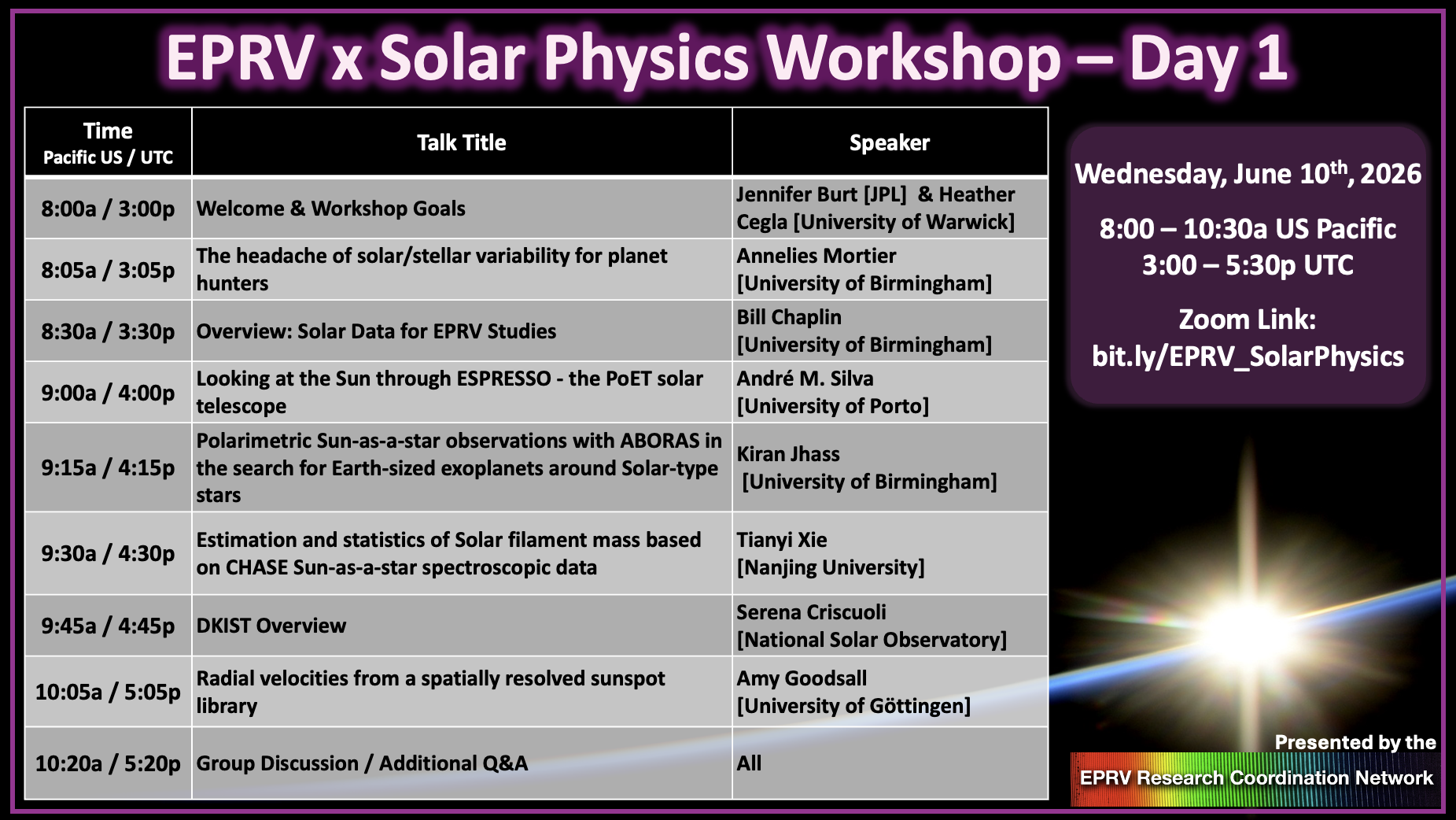
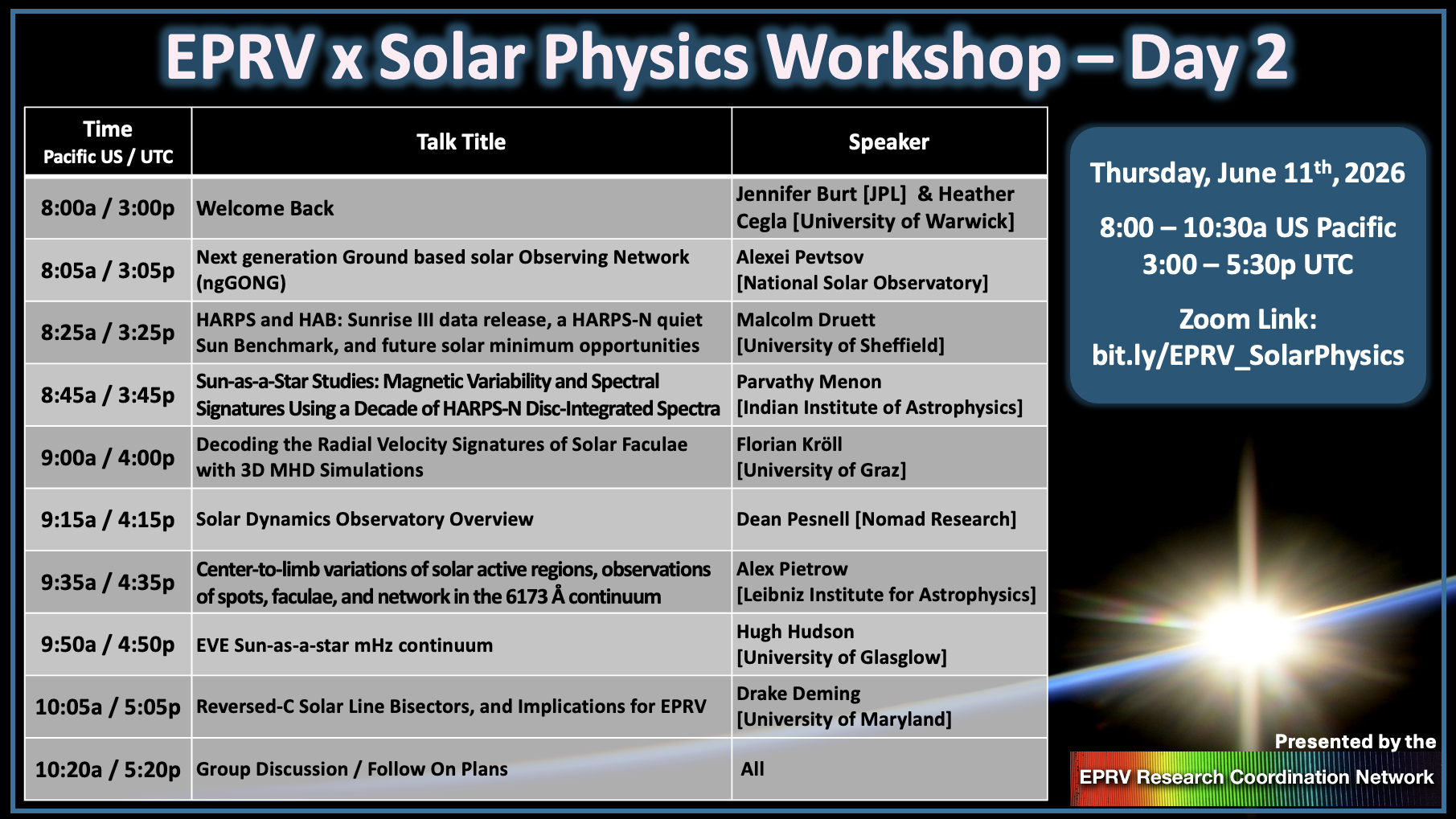
The Extreme Precision Radial Velocity Research Coordination Network (EPRV RCN) hosted an on-line workshop focused on the synergies between EPRV and solar physics on Wednesday, June 10th & Thursday, June 11th, 2026, from 3:00 - 5:30p UTC / 8:00 - 10:30a Pacific US time each day. The goal of this workshop was to explore potential synergies amongst data/facilities/analysis methods between EPRV solar facilities and the solar physics community, raise awareness of resources developed by each community, and spark new collaboration ideas.
If you have any questions please reach out at: eprv-rcn.leads@jpl.nasa.gov
Workshop Agenda
Additional workshop context:
The Extreme Precision Radial Velocity (EPRV) community aims to robustly detect temperate, Earth-mass planets
orbiting nearby Sun-like stars via Doppler shift signatures in high resolution, visible spectra. For context,
the RV signal of the Earth around the Sun is only 9 cm/s, while the variability introduced by (primarily) magnetic
phenomena on the Sun are 1-5 m/s even during low activity spans. The largest amplitude effects arise from spots
and faculae, alongside their modulation over the magnetic cycles, but oscillations, granulation, and super-granulation
remain a challenge for our community as well; supergranulation in particular may present one of the most fundamental
barriers to exoplanet detection due to its longer timescale and poorly understood origin (see figure below and the recent
Precise Radial Velocities
Annual Reviews article for further comparison between relevant signals). We are working to disentangle these phenomena
from the wholesale Doppler reflex motion induced by planetary companions by identifying their signatures in the spectra
across the visible domain used for exoplanet hunting.
Within the RV field, small diameter, solar-telescopes that feed our high resolution (R~100K), visible (~400-900nm) spectrographs have collected years of stabilized, high cadence, high SNR, disk- integrated spectra of the sun (see, e.g., Dumusque et al. 2026). We are using these to disentangle line deformations described above from true Doppler shifts, sometimes via comparisons to solar data from (e.g.,) the Solar Dynamics Observatory and sometimes via RV-only analyses.
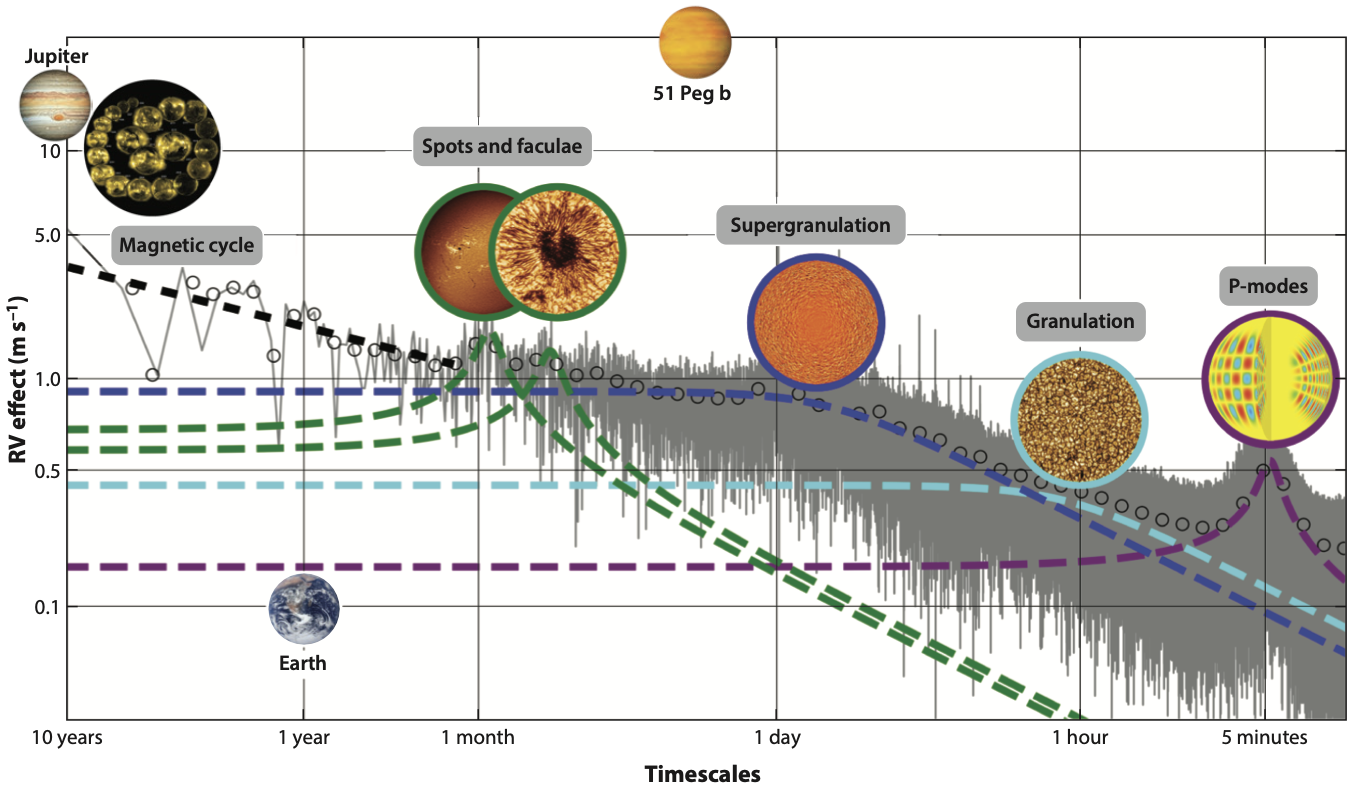
Summary of the approximate timescales and RV semi-amplitudes of the stellar phenomena that most directly impact EPRV science efforts for a Sun-like star, with the RV semi-amplitudes of Earth, Jupiter, and 51 Peg b for reference. These phenomena span timescales from minutes to decades and RV semi-amplitudes of cm/s to dozens of m/s which poses significant challenges for designing RV survey and analysis techniques that can accurately sample, model, and mitigate their impacts. The background grayscale image represents the solar power spectrum density from Al Moulla et al. (2023) with fitted contributions for the different stellar phenomena as colored dashed lines. Figure 9 from Burt et al. 2026, adapted from Al Moulla et al. (2023) and a figure concept from Ryan Rubenzahl.